How to Get a Home Loan?
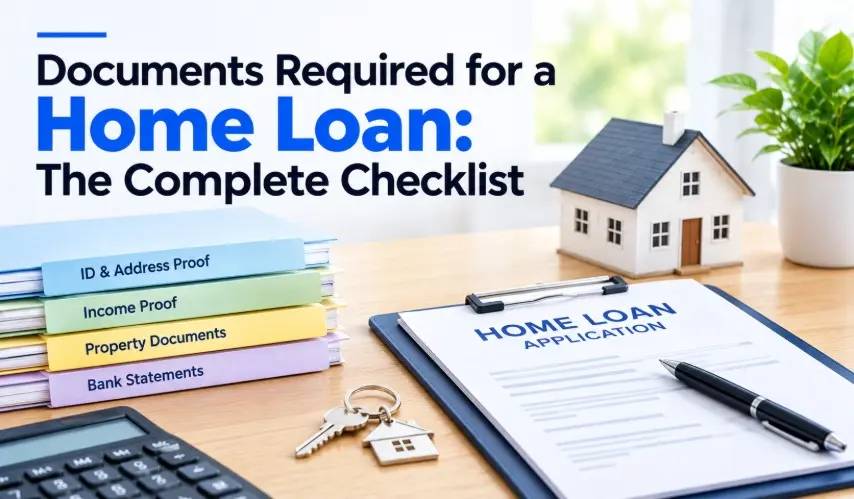
Documents Required for a Home Loan: The Complete Checklist
Applying for a home loan can be a lot. It is easy to feel stressed when you are sorting forms while also thinking about a new place to live. Still, once you see what papers you need, things get simpler.
If you work for a company or if you are self-employed, getting your documents ready ahead of time can help your application move faster. Below is a clear list of what to gather.
1. Identity Proof
The lender starts by verifying who you are. They stop until this step is finished.
You can give them any one of these documents:
Aadhaar Card
PAN Card
Passport
Voter ID
Driving License
They usually accept it if the document is from the government and has your picture on it.
2. Address Proof
Need to confirm your home address today; upload one of the following:
Aadhaar card.
Utility bill for electricity, water, or gas. It should be no older than about 2 to 3 months.
Passport.
Rental agreement, if you are renting.
3. Income Proof
For a staff position, you will be asked to share some documents.
Firstly send your payslips for last 3 to 6 months. Next, provide Form 16. If you do not have it, submit your tax returns instead. Use the past 2 to 3 years. Also, attach your bank statements. These should clearly show salary paid into your account for the last 6 months. Finally, include proof of earlier work. An appointment letter works, or you can use a work certificate.
For Self-Employed Individuals:
ITR for the past 2 to 3 years, including how income was computed.
Profit and Loss account statement, plus Balance Sheet. If needed, keep audited versions too.
Proof for business continuity, like the registration papers and GST returns.
Bank statements from the last 6 to 12 months. Include statements for both personal accounts and business accounts.
4. Property Documents
The loan is tied to the property, lenders ask for detailed paperwork:
Sale agreement, or Agreement for Sale, Title deed, plus the full record of who owned it earlier
Approved building plan, sanctioned by the local authorities.
Encumbrance Certificate, to show the property has no pending legal dues.
Occupancy Certificate, only if the place is ready to move in.
No Objection Certificate (NOC) from the builder or society, when it is needed.
The most recent property tax receipts.
5. Bank Statements
Many lenders request bank records for a period of 6 to 12 months. They look at how money moves in and out each month. They also check your savings habit. In addition, they review any current debts you already have.
6. Passport-Sized Photographs
A few recent passport-sized photographs are typically required to complete your application form.
7. Loan Application Form
You must submit a full application form. It needs to be filled out and signed. The form must be the one the lender gives you. You also have to include every supporting document.
8. Additional Documents (If Applicable)
Form 26AS (Income Tax Credit Statement).
Loan application processing fee cheque details.
Loan details you already have, if any.
Documents needed for the co-applicant, if you apply as a pair.
Quick things to do before you start
Keep two versions of each document. Save the digital file and also print a copy. Some banks take online forms, but they may still request paper later.
Before you press submit, look at your CIBIL score. Scores near 750 or more are often favored. This can affect your approval odds and your interest rate.
Get the property papers checked by a lawyer or some other legal expert. It helps you to find out problems earlier not at the last step.
Make sure all forms display the same details. Small gaps in your name or address can cause delays.
Final Thoughts
Home loan paperwork can feel like a lot at first. Still, when you split it into smaller parts, it is easier to handle.
If you get your documents together before you start looking at houses, you may cut down on delays. You can also avoid extra back and forth with your lender. In the end, you move faster toward the next step of getting your new place.







.webp)