The history of Saidapet stands out from the other neighborhoods in Chennai, which all have their own historical backgrounds. The area of Saidapet, which lies next to the Adyar River, has developed from its origins as a small colonial town into a thriving metropolitan area, which now forms part of Chennai's recent expansion.
As you walk through Saidapet's busy streets, you will see a distinct contrast between the way things were done in the past and those that are being done today. You can find everything from traditional bazaars to ancient temples to modern public transport connecting with all of the new commercial developments. None of this would have been possible without maintaining the area's strong sense of identity and heritage.
Saidapet's Historical Roots
Saidapet's rich history reflects the tremendous changes that occurred in Chennai's development over time. The quiet contribution of Saidapet toward urbanisation was at the heart of improving day-to-day living and contributed greatly to the growth of the city.
Originally a part of the British East India Company's administration during the 18th century, Saidapet quickly developed into the administrative centre of Chingleput District and, from 1859 to 1947, served as the District Headquarters for this District, providing the basis for much activity and development in the area. Following Independence, the District Headquarters were relocated from Saidapet to Chengalpattu, marking a new chapter in the administrative history of the city.
The bridge, which spans the Adyar River, is one of several significant historical sites in Saidapet. The bridge connects both the northern and southern ends of Saidapet, but also continues to be a vital point of crossing between the two ends. The previous bridge was built in 1726 and was known as the Marmalong Bridge and was constructed by Coja Petrus Uscan, an Armenian merchant and benefactor. The role it played to traders and travelers crossing over to this part of the region was very important at the time. The old bridge was replaced with a new bridge during public works-related activities throughout the urban renewal of the others, which took place in the early 1960s.
Incorporation into the municipal corporation of the City of Madras in 1945-46 made Saidapet part of the city of Madras. Integration into the municipal corporation of the city of Madras thereby facilitated increased growth rates and additional development, thus strengthening ties to the city.
Saidapet has been molded by the industrious communities living there. For many years, the local weaving industry flourished within the area, and many weavers resided there as well. The hand loom provided a viable income for weavers long into the late 20th century. Daily life was accompanied by the sounds of looms in full operation as artisans passed down their craft.
Over time, Saidapet faced various challenges, as with any historic settlement. In prior decades, such as the late 1940's, the area faced health issues like filariasis, which were common in those years. But improved public health systems, along with advances in modern medicine, helped reduce these challenges.
Today, Saidapet is an historical neighborhood that displays a wealth of history through the architecture of its bridges, streets, and communities. The richness of Saidapet's Colonial administrative past is woven together with the beauty of its modern urban nature to create an area that thrives on history while continuing to build its future.
The Benefits of a Prime Location
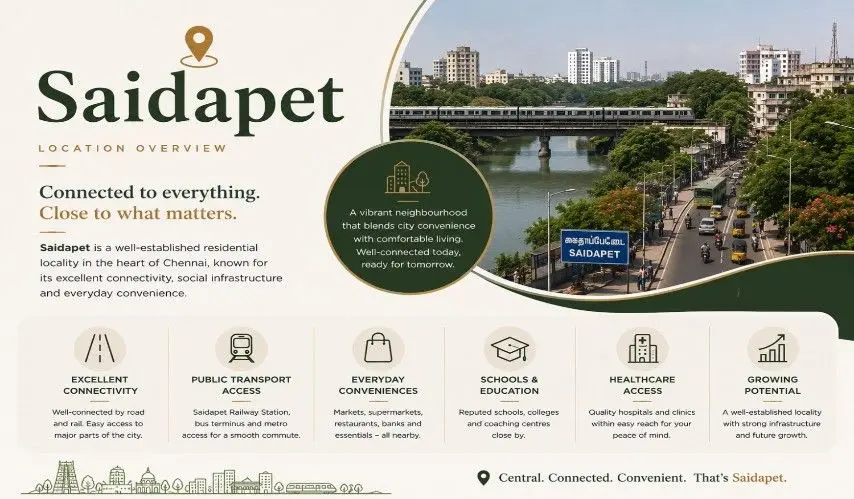
The location is one of the biggest advantages of Saidapet. Located between some of Chennai's largest commercial areas, this makes commuting easier for those who reside in Saidapet.
Major commercial areas like T.Nagar, Guindy, and Nandanam are all a short drive from Saidapet, so whether you're going shopping, to work, or to school, you won't have far to go - they're all accessible by public transportation.
In addition, there are numerous public transportation options, e.g., a metro system and suburban rail, so it's easy to get to and from work from Saidapet using the major freeways that lead to other major commercial or residential communities in Chennai.
Because of how accessible work is from Saidapet, many working professionals look to place their children in daycare facilities located in the area as a way to help give their children a great head start on a successful life.
Connectivity by Road
Anna Salai (Mount Road) is one of the major roads crossing Saidapet and provides a direct connection to various key locations throughout Chennai.
The Inner Ring Road provides an easier route to other significant local areas such as Koyambedu, Vadapalani, and Guindy.
Several Metropolitan Transport Corporation (MTC) buses service Saidapet frequently; MTC provides public bus service throughout the city.
Connectivity by Rail
The Saidapet Railway Station is part of the Chennai-Beach-Chengalpattu suburban railway system, with train service to various important cities located in the outer area of Chennai, including Chennai Beach's train station, from where trains run regularly into central Chennai; Egmore's railway station; and Tambaram's train station, which offers frequent train service into and out of Greater Chennai.
Distant transportation access is provided for Saidapet Metro Station on the Blue Line and connects it to such major destinations as Chennai Central Railway Station and Chennai Airport.
The Lively Streets of Saidapet
Saidapet is one of the happening neighborhoods. Every day starts with an action-packed morning when vendors are setting up vegetables for sale in the local market, and the aroma of filter coffee brings out all the early morning workers, as well as those going to school.
The neighbourhood markets in Saidapet are some of the best.
You can purchase fresh fruits, vegetables, grocery items, clothes, and everyday items from the very large variety of vendors on the roads in Saidapet.
There are many small restaurants and street food vendors that serve authentic South Indian cuisine, making Saidapet the place to go if you are a foodie. Whether you enjoy crispy dosas, fluffy idlis, or hot cups of filter coffee, the food culture in Saidapet is simple but exceptional.
Why Saidapet Remains a Favorite
Saidapet possesses an aspect that is commonly absent from most new communities: individuality. While Saidapet is not just made up of structures and streets, it has a history of being a supportive neighbourhood with ties that have been developed through time.
The mix of heritage, access to transport links, and proximity to essential services has continued to attract new members into Saidapet while concurrently ensuring that families that have lived in Saidapet for decades remain in place.
Saidapet is an excellent example of what makes the City of Chennai the wonderful city it is today: A vibrant, welcoming community that is rich in traditions and culture!
Saidapet Synopsis
Pincode | 600015 |
City | Chennai |
Zone | South |
District | Chennai |
State | Tamil Nadu |
Country | India |
Saidapet Landmark
Saidapet Metro
Saidapet, Chennai, Tamil Nadu 600015
New Life Assembly Of God Church
6, Anna Salai, NGR Colony, Little Mount, Saidapet, Chennai, Tamil Nadu 600015
Saidapet Bus Depot
Taluk Office Rd, Venkta Puram, Saidapet, Chennai, Tamil Nadu 600015
Commuting Distance
Airport | 9.4 km |
Koyambedu Bus Stand | 9.2 km |
Central Railway Station | 9.9 km |
Egmore Railway Station | 9.2 Km |
Kilambakkam Bus Stand | 24.6 Km |
Nearest Railway Station- Saidapet Railway Station | (500 M) |
Nearest Metro Station- Saidapet Metro Station | (650 M) |




.webp)

.webp)